Why Is My Water Heater Popping?
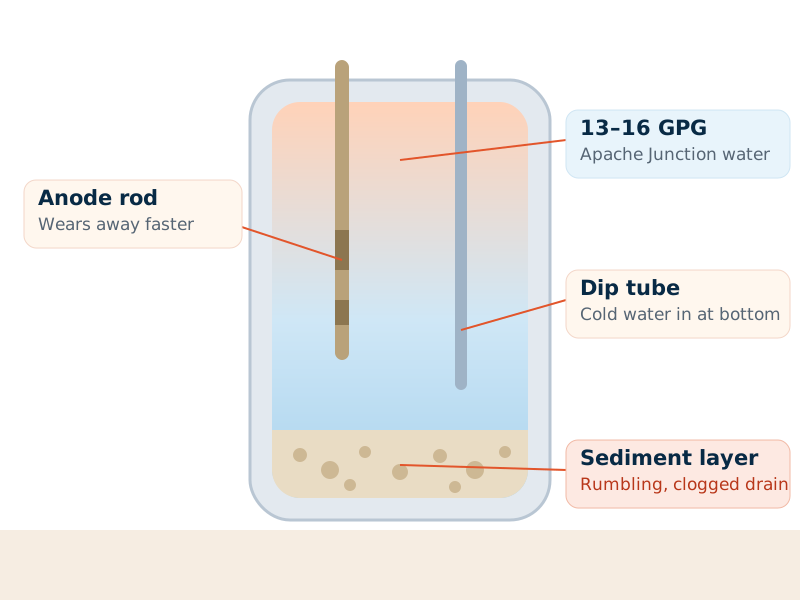
A popping noise usually means a layer of hard-water sediment has collected across the tank bottom. Small pockets of water get trapped under it, overheat and burst into steam bubbles, which pop as they escape. It's usually not dangerous on its own, but it wastes energy and stresses the tank. A flush often quiets it.
Think of a pot of water with a layer of sand in the bottom. The water under the sand can't move freely, so it overheats in small spots and bursts upward. The same thing happens in a water heater, and in Apache Junction, where the water measures roughly 13–16 grains per gallon of hardness, that sand layer builds faster than in most places. Our guide to hard water in Apache Junction explains where those minerals come from.
Gas and Electric Heaters Make Different Sounds
Why does a gas water heater pop or rumble?
On a gas tank, the burner heats the bottom of the tank from below. Sediment sits right on that hot surface, so water trapped in it flashes to steam. You hear popping or a low rumble mostly while the burner is running, and it often gets louder over months as the layer grows. A rumble is just many pops close together.
Why does an electric water heater sizzle or hiss?
Electric tanks heat from elements that stick into the water. In hard water, minerals form a crust right on the elements, and water touching that hot crust sizzles or hisses. Sediment can also pile up around the lower element and make it pop like a gas tank. A badly scaled element runs hotter than it should and tends to burn out sooner; our electric water heater repair page covers testing and replacing them.
Other Water Heater Noises and What They Mean
Not every sound is sediment. Here's a quick guide to the rest.
| Sound | Likely cause | What to do |
|---|---|---|
| Ticking or tapping in the pipes | Pipes expanding and shrinking as hot water flows, or heat-trap fittings on top of the tank | Usually harmless; pipe straps can help |
| Screaming or high whistle | A partly closed valve, or water or steam forcing past the relief valve | Check the valves are fully open; if the relief valve is discharging, turn the heat off and call |
| Sizzling on a gas unit | Water dripping onto the burner, from condensation or a leak | Watch whether it stops once the tank is hot |
| Low hum on an electric unit | A loose element vibrating as water flows past | Often harmless; we can snug it during a service |
| Banging when a tap closes | Water hammer in the house pipes | Not the heater itself; often high water pressure |
Is sizzling on a gas heater condensation or a leak?
Condensation forms on the cold flue when the tank is full of fresh cold water and the burner fires, then drips onto the flame. It should stop once the tank is hot. Sizzling that goes on all the time, or a puddle that keeps growing, points to a leak. Our condensation vs. leak guide has two simple tests.
Why is my relief valve making noise?
A hiss or a short burst from the relief valve pipe means it is releasing water or pressure. A drip now and then, often overnight, usually points to thermal expansion in a closed system, which an expansion tank handles. A valve that blows hot water or steam is a safety event. Our relief valve leaking guide explains the difference.
Is a Popping Water Heater Dangerous?
On its own, usually not. A tank that pops while the burner runs isn't about to explode. The relief valve and the gas control or high-limit switch are there to stop pressure and temperature from running away, and sediment noise doesn't change that.
What popping does do is cost you, slowly:
- Wasted energy: sediment acts like a blanket between the heat source and the water, so the heater runs longer.
- Less hot water: sediment takes up room in the tank, and you may notice hot water running out sooner.
- A hotter tank bottom: on gas units, the steel under the sediment runs hotter, which wears the glass lining.
- Shorter element life: on electric units, scale cooks the elements.
Safety: Popping plus any of these needs a call, not a flush: the relief valve discharging hot water or steam, tap water much hotter than normal, a gas smell, or water on the floor. Any gas smell means everyone goes outside, and you phone 911 and Southwest Gas from there.
How to Stop a Water Heater From Popping
Will flushing the tank fix it?
Often, yes, if the sediment is still loose. A flush drains the tank and washes the grit out through the drain valve. If you'd like to do it yourself, our how-to-flush guide walks through the steps and the safety points. If the drain valve is old plastic or the tank is older, a professional flush includes checking the anode and relief valve while the tank is empty.
What if the sediment has hardened?
A flush may only quiet it partway. Some makers allow a descaling solution made for water heaters, run through the tank and flushed out. Check your heater's manual before using any chemical, because the wrong product can harm the lining or void the warranty. On electric tanks, replacing crusted elements often stops sizzling right away.
How do I keep the popping from coming back?
- Flush yearly in water as hard as ours
- Keep the temperature at about 120°F; hotter water drops minerals faster
- Have the anode checked every few years
- Consider a water softener if you want to cut sediment at the source
When Popping Means the Tank Is Near the End
Noise alone doesn't tell you a tank is failing. But loud rumbling on an older tank, especially one that doesn't quiet down after a flush, often means years of hardened sediment and a tank bottom that has run hot for a long time. Put that together with age and other signs and the picture gets clearer:
- The tank is more than about 8 to 10 years old; check the serial number
- Rusty hot water, or rust at the base or fittings
- Moisture under the tank or wet insulation behind an access panel
- The noise got much louder in a short time
Hard water means many local tanks show trouble by 7–9 years; we cover the reasons in our Arizona water heater lifespan post. Our repair or replace guide helps you weigh a flush against a new heater. If water has already reached the floor, our water heater leak repair in Apache Junction service is open 24/7 at +1 480-863-0807.
Do Tankless Water Heaters Make Popping Noises?
Less often, because they don't hold a tank of water over a burner. Scale inside a tankless heat exchanger can cause knocking, rattling or sputtering sounds, along with temperature swings and error codes. Yearly descaling is the usual fix. If your tankless unit is noisy and showing codes, see our tankless repair service.
Water Heater Noise FAQs
Why did my water heater start popping right after a flush?
A flush can stir up hardened sediment and break it into pieces that settle in new spots, so the noise can change or even get louder for a few days. It often settles down after a few heating cycles. If it's still loud after a week, a second flush may help, or the sediment may be too hard for flushing to clear.
Is it normal for a new water heater to make noise?
Some quiet ticking from the pipes as they warm, or a soft whoosh when a gas burner lights, is normal on any heater. Popping from a brand-new tank is less common, though very hard water can start it within the first year or two. Loud banging, screaming or hissing from a new unit should be checked, because installation issues are easier to fix early.
Does a popping water heater use more gas or electricity?
Yes, usually somewhat more. Sediment sits between the heat source and the water, so more of the heat goes into the steel and the grit, and the heater runs longer to reach its setting. How much more depends on how thick the layer is. Regular flushing is the cheapest way to keep that waste down in hard water.
Why does my water heater pop only at night?
It may pop all the time, but you only hear it when the house is quiet. Many heaters also run longest late in the evening and early in the morning, after showers and dishes refill the tank with cold water. That's when trapped water under sediment heats fastest, so the popping peaks then.
Can I turn the temperature down to stop the popping?
Lowering a high setting to about 120°F can soften the noise a little and slows new mineral buildup, but it won't remove the sediment that's already there. It's a good habit, not a fix. The layer on the bottom still needs flushing out, or on an electric tank, the crusted elements may need replacing.